The word hamsa is Arabic for five, and five, in the Jewish tradition, carries its own weight. The Hebrew word for five is hamesh, and the fifth letter of the Hebrew alphabet, heh, is among the abbreviated names by which God is written without being fully written. When Kabbalists considered the significance embedded in the hamsa's five fingers, the number was not incidental. Five also evokes the five books of the Torah, the Chamisha Chumshei Torah, for which the fingers become a kind of mnemonic held in the palm of a hand.
In the Sephardic tradition, the hamsa is often called the Hand of Miriam, connecting the symbol to Miriam the prophetess, sister of Moses and Aaron, whose watchfulness over the infant Moses in the Nile set the entire story of Exodus in motion. The hand becomes, in this reading, a hand that watches over: one that reaches toward danger and returns with the child intact. That protective meaning has persisted across centuries and across geography, from the Jewish communities of Morocco and Tunisia to the Ashkenazi households where the symbol arrived later, carried along trade routes and through cultural exchange.
A Symbol Shared Across Traditions
The hamsa's complicated belonging is part of what makes it worth understanding. It appears in Jewish, Islamic, and broader Mediterranean traditions with roughly the same protective meaning, and it predates the formal establishment of any of those traditions as we know them. Arab Muslims call it the Hand of Fatima, connecting it to the daughter of the Prophet. Berber communities in North Africa carried versions of the five-fingered form for centuries before the Kabbalistic interpretations of it fully took shape.
This shared history has become a source of both friction and conversation in recent decades. Some Jewish voices argue that a symbol worn without knowledge of its particular Jewish lineage risks losing meaning in the wearing. Others point to the hamsa as evidence that protection, as a human impulse, crosses every boundary, and that the symbol is large enough to carry all of its histories at once.
For those who wear it as Jewish jewelry, the meaning most often expressed is protective: the open hand held outward to deflect harm, the palm a kind of mirror that turns the gaze of envy away from the wearer before it can settle.
The Eye in the Palm
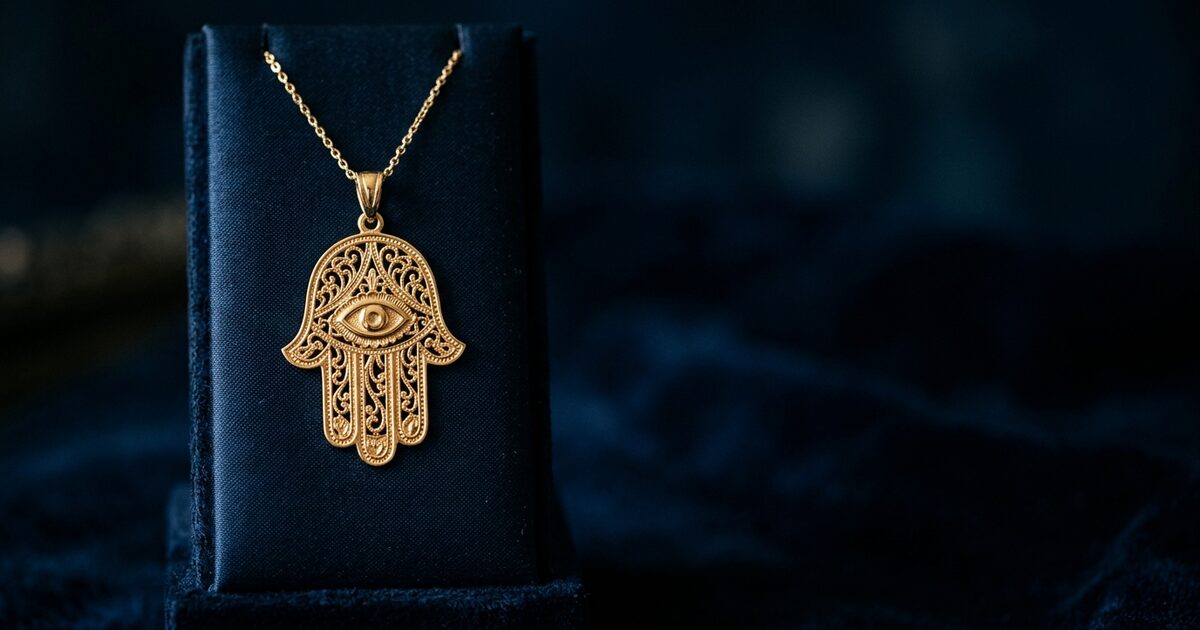
Many hamsa pendants carry a small eye at the center of the palm. This is the evil eye, ayin hara in Hebrew, appearing not as a free-standing symbol but as something that belongs to the hand itself, as though the hamsa were built from watchfulness. The combination reads as layered protection: the hand that stops, the eye that sees.
Goldsmiths working in this vocabulary make decisions about the eye's material that carry quiet signals. A blue enamel eye set in 14K yellow gold reads as traditionally Sephardic. A diamond-set eye, small and brilliant-cut, places the piece firmly in the fine jewelry register. A lapis lazuli disc with a carved eye at center sits somewhere between: stone rather than metal, an ancient material given a contemporary form.
The eye can also be absent. A clean hamsa in polished gold, with no eye at the center and no inset stone, reads differently: more architectural, more interested in form than in layered symbolism. Both approaches are defensible. They represent different relationships to the tradition.
How Goldsmiths Interpret the Form
The hamsa presents a specific goldsmithing problem. It is, essentially, a stylized silhouette of a hand, which means its proportions must read correctly at the small scales demanded by a pendant or charm. The index and ring fingers are equal in height, slightly shorter than the middle finger, and the thumb curves outward at an angle that distinguishes the hamsa from a naturalistic hand. Get the proportions wrong and the symbol loses its legibility.
Casting yields smooth, clean forms that photograph well and wear without snagging on fabric. Filigree yields openwork pieces with a visual texture that casting cannot replicate. Sheet gold, cut and finished by hand, produces the flattest and most graphic interpretation. Each approach suits a different wearer:
- A solid cast hamsa in 14K gold is a daily protection piece, worn without ceremony and cleaned without worry.
- A filigree hamsa is a considered object, more fragile and more rewarding to examine closely.
- A sheet-gold hamsa with minimal surface detail suits someone who values restraint over ornament.
Wearing the Hamsa Alongside Other Symbols
The hamsa layers well. It shares its protective vocabulary with the evil eye, which is why the two appear together so naturally: in combination pendants, in mixed chains, in collections where neither symbol is chosen over the other. The Star of David brings a different register, more identitarian, less specifically about protection, more about belonging to a people. Stacking a hamsa with a Star of David creates a statement that covers multiple dimensions of Jewish identity at once.
The Chai pendant adds a verbal element to the ensemble. Where the hamsa is an image and the Star of David is a geometric form, the Chai is a word: life. Worn together, the three cover symbol, identity, and language. It is not necessary to read all of that consciously for the combination to feel right.
The hamsa's persistence across centuries and cultures is not accidental. It is old enough to have outlasted every fashion cycle that has touched it. The next question is which form suits the person who will wear it, and what occasion calls for it. Explore the full hamsa jewelry collection or the evil eye collection to find a starting point.