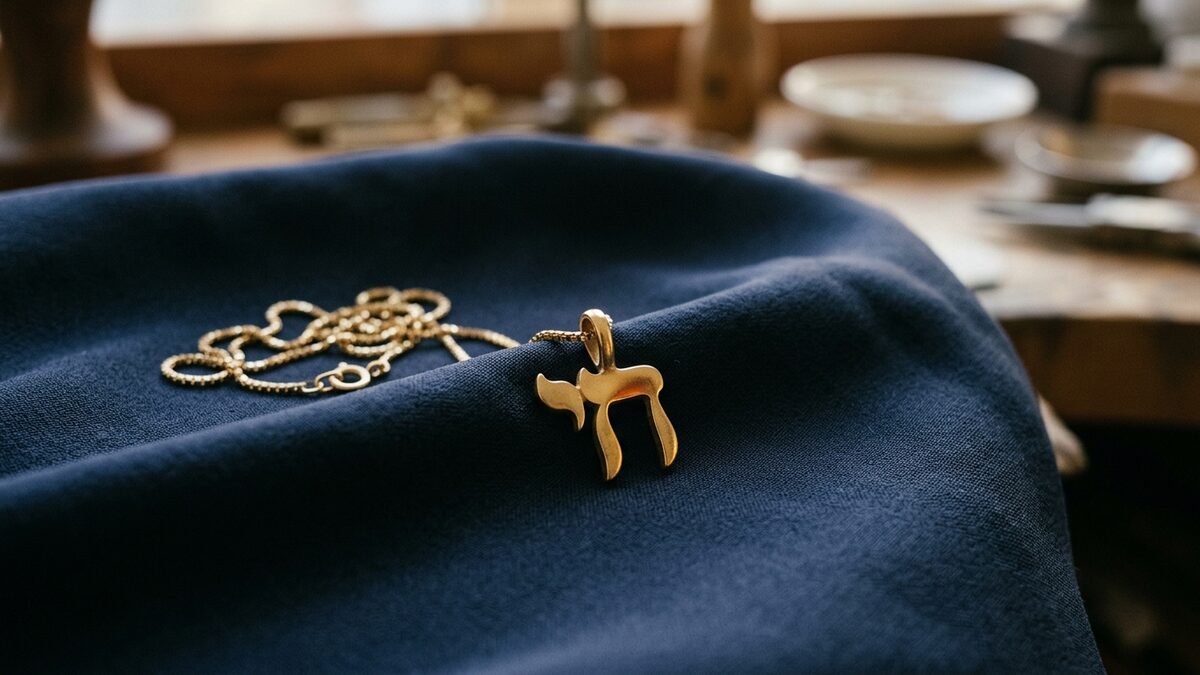
The Chai is small. On most pendants it occupies a span no wider than a thumbnail, and its silhouette is governed by the shape of the two letters themselves. Chet, the broader letter, forms a kind of arch or bridge. Yod, smaller and suspended within or beside it, completes the word. Together they read right to left, as Hebrew does, and the eye learns the order after a few viewings. The form is legible to those who know it and quietly opaque to those who do not, which is part of its character.
The numerical dimension is what gives the symbol its second layer. In gematria, the traditional system that assigns numerical values to Hebrew letters, chet is eight and yod is ten. The sum is eighteen. Eighteen, in turn, has become shorthand for life itself in Jewish practice, the reason charitable gifts are so often given in multiples of that figure, the reason a wedding check might read one hundred and eighty rather than two hundred. A Chai pendant carries that arithmetic on the body. The wearer may or may not be conscious of it at any given moment, but the math is there, folded into the metal.
Goldsmithing traditions have interpreted the form in markedly different registers. The Yemenite school, with its filigree and granulation, tends toward an openwork Chai, the letters constructed from twisted wire and beaded with small gold spheres. The result is delicate, almost lace-like, and reads as much as ornament as text. Eastern European workshops, by contrast, often favored a solid, sculptural Chai, the letters cast in heavier gold with rounded edges and a presence that sits firmly against the collarbone. Contemporary Israeli goldsmiths have moved in both directions, some pursuing minimal, clean-lined interpretations cut from sheet gold, others returning to the granulated vocabulary of older traditions.
Place Within a Larger Vocabulary of Jewish Jewelry
The Chai does not stand alone. It belongs to a small set of symbols that have, over centuries, become the recognizable shorthand of Jewish jewelry: the Star of David, the Hamsa, the menorah, the Hebrew name inscribed in script. Each carries its own register. The Star of David is broadly identitarian, a symbol of peoplehood and, since 1948, of statehood. The Hamsa is protective, with roots that predate any single religious tradition and a meaning shared across Jewish and Arab cultures of the Mediterranean and North Africa. The menorah is liturgical, tied to the Temple and to the festival of Hanukkah.
The Chai sits somewhere distinct within this group. It is neither purely identitarian nor purely protective. It is a word, not an emblem, and the word it spells is life. Worn alongside other pieces, it tends to read as the quieter object, the one that requires a second look to decode. Some wearers stack it with a Star of David on a longer chain. Others wear it alone, on a shorter chain that holds the pendant high against the throat, where the letters are most visible.
Material choices follow predictable lines but reward attention. Yellow gold, particularly in the fourteen and eighteen karat ranges, is the traditional default and remains the most common. The warm tone reads as continuous with older pieces, with heirlooms, with the goldsmithing traditions of the diaspora. White gold and platinum interpretations exist and have become more common in the past two decades, often paired with diamond accents along the chet's upper bar. Rose gold appears occasionally and tends to read as a more contemporary, fashion-forward choice rather than a traditional one. Silver Chai pendants are common, particularly as gifts to children or at bar and bat mitzvah ceremonies, where they function as introductions to a symbol the wearer may carry into adulthood in heavier metal.
The pendant's scale matters more than is sometimes acknowledged. A Chai that is too large reads as costume; one that is too small disappears against the skin and forfeits its legibility. The objects that succeed tend to fall within a narrow band, roughly fifteen to twenty-five millimeters in height, with proportions that give the chet its arch without overwhelming the yod. Older Chai pendants, particularly those from the mid-twentieth century, often have a slightly heavier construction than contemporary equivalents, a function of the metal-pricing realities of their era as much as any aesthetic preference.
What the Chai resists, in the end, is reduction. It is not a brand, not a logo, not a fashion object in the way some contemporary jewelry has become. It is a word in an old language, made into metal, worn close to the throat. The wearer carries the number eighteen without announcement, and the symbol does its work whether anyone else in the room can read Hebrew or not. That quietness is, perhaps, the most useful thing to understand about the object.