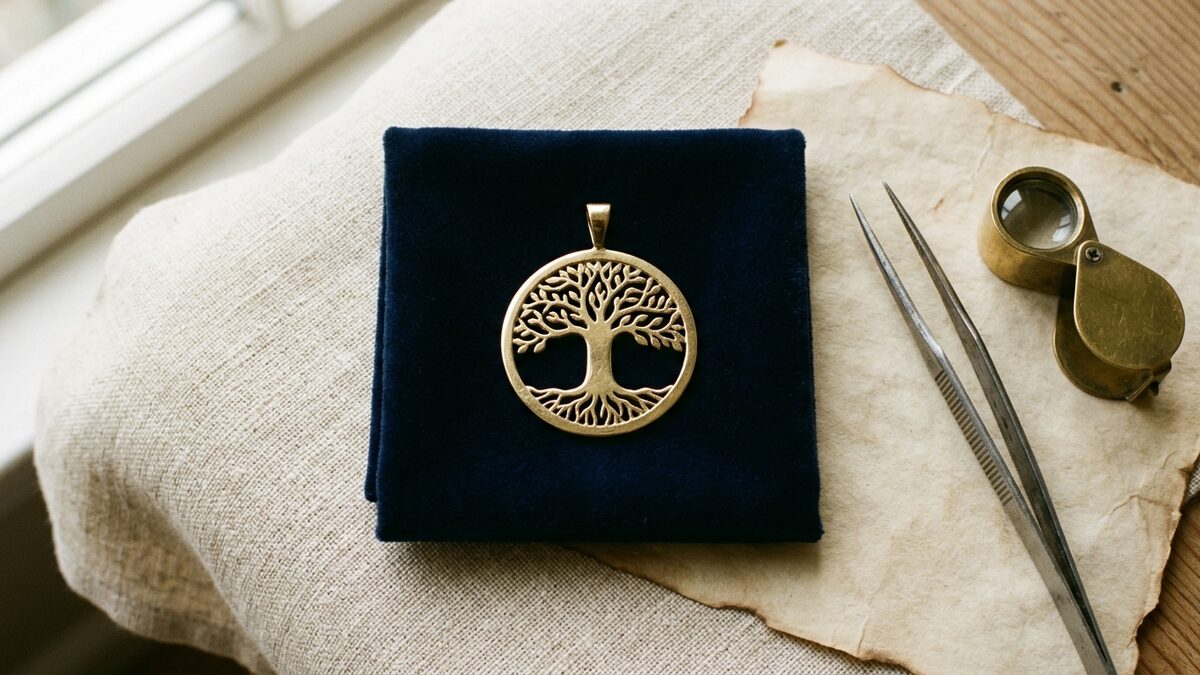
In Hebrew, the motif is called Etz Chaim, the tree of life. Its scriptural footing is older than most wearers realize. It appears in Genesis, in the garden, as the tree whose fruit grants enduring life. It returns in Proverbs, where wisdom itself is described as a tree of life to those who hold her. By the time the phrase reaches the liturgy of the Torah service, it has become a description of Torah itself: a living structure, rooted and branching, meant to be returned to rather than read once.
That layered meaning is why the pendant has carried weight across centuries and communities. It is not a single symbol but a compressed library. A well-made piece acknowledges that. A weaker one treats the tree as a generic nature charm and loses the thread.
The kabbalistic geometry beneath a serious design
The deepest reading of the tree comes from kabbalah, where the Etz Chaim is rendered as a structured diagram of ten sephirot, the divine emanations, connected by twenty-two paths. The arrangement is not decorative. Each node sits in relation to the others according to a specific logic of mercy, severity, and balance, and the paths between them correspond to the letters of the Hebrew alphabet.
Most pendants do not attempt to render the full sephirotic diagram. That is reasonable, since the geometry is dense and the scale of a pendant is small. What a thoughtful pendant does instead is borrow the diagram's discipline. The branches are balanced rather than random. The trunk reads as a true vertical axis. The canopy resolves into a clear silhouette rather than dissolving into filigree noise. When you hold a considered piece against a casual one, the difference is immediate, even if you cannot name what you are seeing.
There is also a quieter convention worth knowing. Some workshops will set the roots and the branches as mirror images of each other, a small visual acknowledgment of the kabbalistic idea that what is above is reflected in what is below. It is the kind of detail that a wearer may never consciously notice and yet feels right.
How to read a pendant before you wear it
A few details separate a thoughtful Tree of Life pendant from a generic one, and most of them are visible on close inspection.
The first is the canopy. A serious design gives the canopy weight, often through a circular frame or a deliberate negative-space halo around the branches. This is not ornament for its own sake; it draws the eye to the tree as a whole rather than to a tangle of metal. A pendant without this discipline tends to read as busy at any size.
The second is the trunk. On a well-made piece, the trunk is a single confident line, thicker than the branches and rooted with intention. Generic designs often taper the trunk into a vague point or let it disappear into the bail. The bail itself is a useful tell. A workshop that respects the motif will integrate the bail into the design rather than soldering a stock loop to the top.
The third is the back. Turn the pendant over. A considered piece will either finish the reverse with the same care as the front, or it will inscribe it: a verse fragment from Proverbs, the words Etz Chaim, or a date. A back that is rough, hollow, or stamped only with a metal mark is a sign that the maker treated the piece as inventory rather than as an object meant to be lived with.
Choosing a piece that will hold up
Material choice matters less than proportion, but it is not nothing. Yellow gold remains the traditional choice, in part because the warm tone reads as botanical and in part because it ages without losing its character. White gold and platinum can work, particularly in more architectural interpretations of the motif, but they ask for a cleaner geometry to balance the cooler tone. Silver is honest and historically appropriate, and a well-finished silver piece can outlast its owner with reasonable care.
Size is the quieter decision. A pendant that is too small loses the structural reading entirely and becomes a vague charm. A pendant that is too large stops being jewelry and becomes costume. For most wearers, a piece between eighteen and twenty-six millimeters across the canopy gives the design room to read while staying within the register of everyday wear.
The Tree of Life is one of the few motifs in Jewish jewelry that is both ancient and constantly being reinterpreted. The best contemporary pieces honor the geometry without freezing it, and they leave room for the wearer to bring their own reading. That, in the end, is what the motif has always asked for.