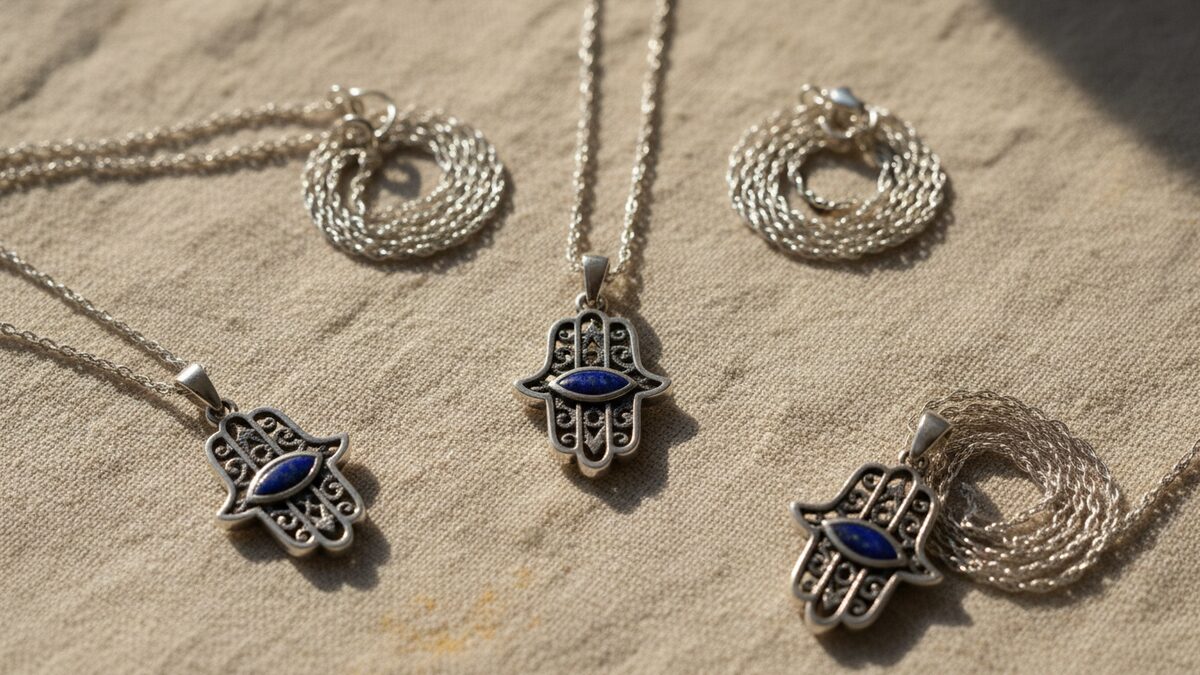
The Hebrew phrase ayin hara, often rendered as evil eye in English, describes a folk belief that envious or admiring attention can carry weight, and that an object worn close to the body can serve as a quiet counterbalance. The concept appears across Talmudic discussion, where the tradition treats it less as a supernatural threat and more as a recognition that attention itself has consequences. Communities in the Mediterranean basin, the Maghreb, and across the Sephardic diaspora developed their own protective objects in response, and the visual motif of an eye looking outward, watching for what the wearer cannot see, emerged independently in several of these regions. Jewish silversmiths working in Morocco, Yemen, and the Ottoman territories incorporated the symbol into amulets that were often gifted at births, weddings, and other moments when a family felt particularly visible.
How the motif developed alongside the hamsa and chai
The evil eye rarely traveled alone. In Sephardic and Mizrahi traditions, the eye most commonly appears set within a hamsa, the open-palm form that itself functions as a protective gesture. The combination layers two ideas: the hand that wards off and the eye that watches back. Ashkenazi traditions absorbed the motif later and treated it more sparingly, often pairing it with the chai or with text-based amulets carrying verses from Psalms. By the nineteenth century, jewelers in Jerusalem, Salonika, and Aleppo were producing pendants that combined all three elements in compact silver compositions, and surviving pieces from this period show how restrained the work could be. The eye is small, often no larger than a fingernail, and rendered in enamel, lapis, or a simple disc of inlaid stone. It reads as quiet rather than declarative, which is the quality contemporary makers still try to preserve.
What changed in the twentieth century was the migration of the symbol into mass-market jewelry, where it was often flattened into a graphic cartoon of a blue circle with a black pupil. That version of the evil eye is everywhere now, on string bracelets sold at airports and on costume pieces that have nothing to do with the underlying tradition. The graphic version is not wrong, exactly, but it has very little in common with what a Jewish family in Fez or Thessaloniki would have recognized as protective jewelry a hundred years ago. The older objects feel weightier in the hand, sit closer to the skin, and use the eye as one element in a larger composition rather than as the entire point of the piece.
How contemporary makers approach the evil eye today
The most considered current work in this category tries to recover the restraint of the older tradition while making something that reads as contemporary rather than antique. Pendants tend to be small, often under fifteen millimeters, and the eye is rendered as inlay rather than as printed enamel. Lapis lazuli remains the traditional stone, both because of its color and because of its historical association with protective objects across the ancient Mediterranean. Some makers substitute sodalite or a deeper synthetic spinel when sourcing is difficult, and the substitution is usually visible only on close inspection. The setting is almost always silver or low-karat gold, and the bezel is typically rubbed-over rather than prong-set, which keeps the surface flush and the piece quiet against the chest.
Chain choice matters more than it might seem. A heavy curb chain overwhelms the pendant and turns the whole composition into something louder than the symbol asks for. A thin cable or box chain, usually between one and one and a half millimeters, lets the pendant sit at the collarbone without announcing itself. Length is a personal decision, but pieces in this tradition are most often worn between forty-two and forty-six centimeters, which places the pendant just below the hollow of the throat rather than further down the sternum. This is the placement seen in surviving photographs of women wearing protective jewelry across the Sephardic communities of North Africa, and it remains the most flattering position for a small protective object on most adult wearers.
For a wearer choosing a piece today, the questions worth asking are practical. Is the eye rendered in actual inlay or printed onto a surface that will wear over time. Is the back of the pendant finished as carefully as the front, which is the traditional marker of a piece made to be lived with rather than displayed. Does the chain feel proportionate to the pendant, or has it been chosen for visual weight rather than for how the object will actually sit. These are not aesthetic preferences so much as inheritances from a tradition that treated protective jewelry as something worn daily and quietly, not as a statement to be read across a room. The best contemporary pieces honor that inheritance, and the result is jewelry that feels personal rather than performative, which is what the tradition asked for in the first place.