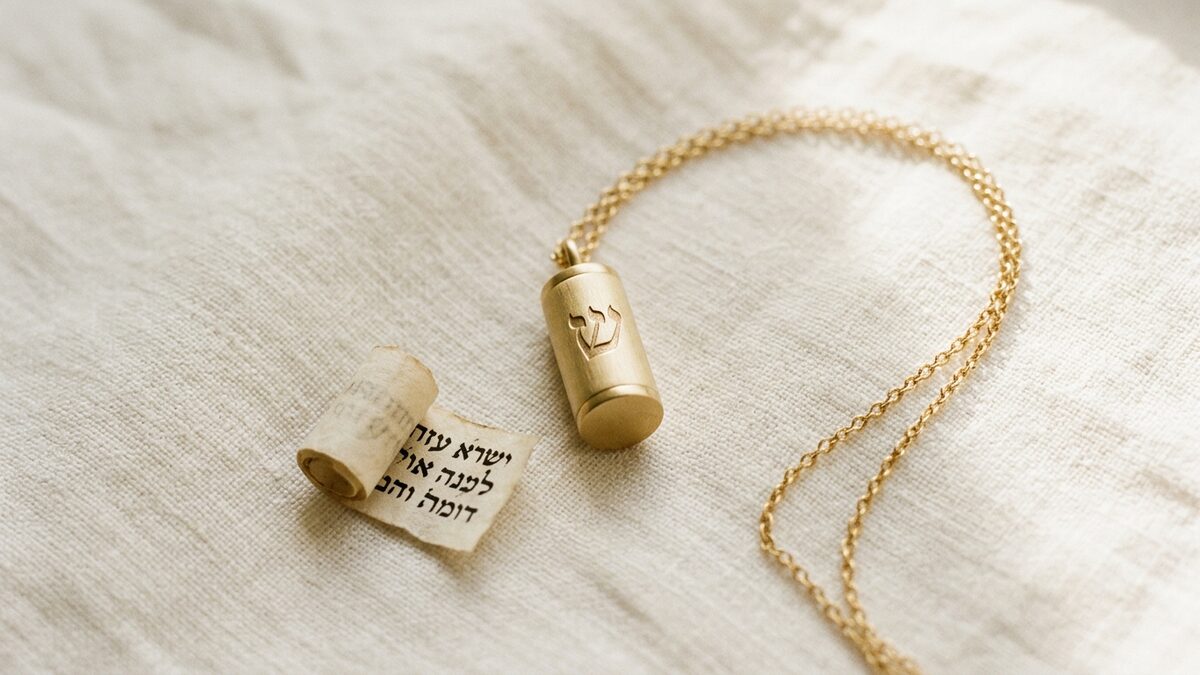
Inside the traditional mezuzah is the klaf, a small parchment hand-lettered by a sofer with passages from Deuteronomy, including the Shema. The case is a vessel for that text. When the case becomes a pendant, the question is whether the klaf travels with it. Some pendants are made to hold a miniature scroll, sized to the case and prepared specifically for wear. Others are symbolic, with the form of the case preserved but the interior left empty or sealed. Both approaches exist in the market, and the choice is a personal one, often made in conversation with a rabbi rather than a jeweller.
The letter Shin and the architecture of the case
On most mezuzah cases, the Hebrew letter Shin appears on the front. It stands for Shaddai, one of the names of God, and also serves as an acronym tied to the line Shomer Daltot Yisrael, guardian of the doors of Israel. On a pendant, the Shin is the first visual cue, the element that signals the object's meaning to anyone who recognises it. Jewellers handle the letter in different ways. Some engrave it cleanly into the metal, letting the line work carry the whole design. Others raise it in relief, or set it against a contrasting surface, polished against matte, yellow gold against white. The treatment of the Shin tells you a great deal about the maker's sensibility before you read anything else about the piece.
The case itself can be tubular, rectangular, or shaped like a small architectural form. Some contemporary pieces lean into the architectural reading and suggest a tiny doorway in miniature, with a frame and a lintel. Others reduce the form to a cylinder, almost industrial in its restraint. The traditional mezuzah on a doorpost is mounted at an angle, leaning toward the room being entered, and a few pendant makers preserve that tilt by setting the Shin slightly off-axis on the case. It is a quiet detail, legible only to those who know to look for it.
Metal, finish, and the question of scale
Yellow gold remains the most common choice for a mezuzah pendant, partly because of tradition and partly because the warm tone reads well against the Hebrew lettering. White gold and platinum are used as well, and silver pieces are common at more accessible price points. The metal choice carries some weight beyond aesthetics: the piece will be worn often, sometimes daily, and the finish needs to hold up. A high polish will show wear at the edges of the Shin and along the case body within a few years; a brushed or matte finish ages more gracefully but reads less formally. Many makers split the difference, polishing the Shin and the borders while leaving the broader case surface satin.
Scale is the harder question. A mezuzah on a doorpost is typically four to six inches; a pendant version compresses that down to perhaps an inch, sometimes less. The compression changes the object's relationship to its content. A klaf written at pendant scale is genuinely tiny, lettered with a fine nib by a sofer who specialises in micro-scale work, and the parchment is rolled rather than folded. The case has to be sealed well enough to protect the scroll from moisture and abrasion, which is why pendant mezuzahs tend to have screw-tops or soldered closures rather than the friction-fit caps used on doorpost cases.
Wearing the piece
A mezuzah pendant is worn close to the body, usually on a chain long enough to sit at the sternum or just below the collarbone, not at the throat. The orientation is upright, with the Shin facing outward and the case hanging vertically. Unlike a doorpost mezuzah, there is no halakhic requirement to angle the pendant, and most wearers do not. The piece is most often a personal object rather than a public statement, worn under clothing as a daily companion, occasionally lifted out for moments that call for it.
For those receiving a mezuzah pendant as a gift, the consideration is less about luxury signalling and more about the relationship between the giver, the recipient, and the object's meaning. Bat mitzvah and bar mitzvah occasions are common, as are milestones around a new home, a graduation, or a journey. The piece becomes an heirloom in the simplest sense, an object that holds its meaning across decades and across the people who wear it.
What the pendant offers, finally, is a way to carry a domestic symbol into the rest of life. The mezuzah on the doorpost stays where it is; the pendant moves with the wearer, marking the threshold of the body rather than the home. The translation is modest, and the object itself is small, but the gesture has held for generations and shows no sign of fading.