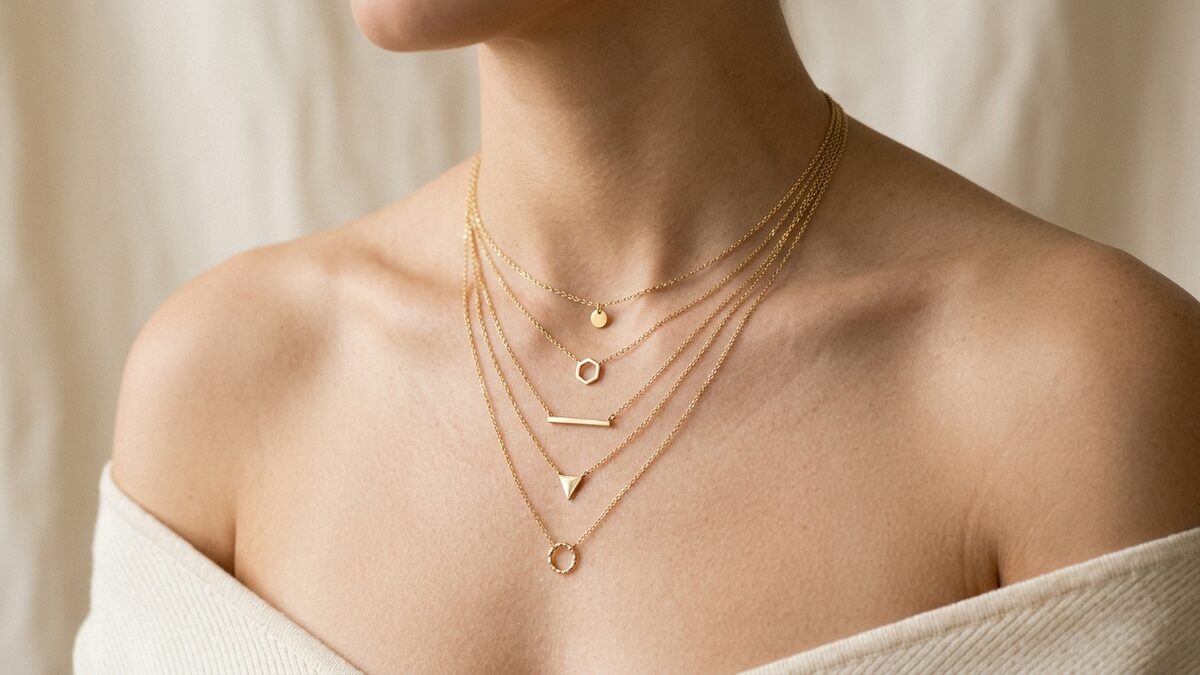
Why layering works for Jewish jewelry specifically
The Star of David is a compact symbol. It does not require much visual space to read; a 14K pendant as small as 12mm across is legible at a few feet. That compactness is what makes it an ideal candidate for layering — it holds its own on a chain without dominating the surrounding pieces.
The Merkabah, being three-dimensional, adds a different kind of presence. It catches light. It rotates slightly on its bail as you move. Paired with a flat Star of David on a shorter chain, the contrast between the dimensional and the flat is part of the composition. You are not just stacking jewelry — you are creating a relationship between forms.
The Hamsa works as the middle layer, its open-hand shape reading clearly even at a small scale. The eye at the center of a Hamsa pendant gives it a focal point that a plain geometric symbol does not have, which means it anchors the layered look visually without needing to be the largest piece.
Chain length: the foundation of any layered look
The rule that actually matters is separation by at least two inches of chain length between each layer. A 16-inch chain sits at the collarbone. An 18-inch chain falls just below it. A 20-inch chain sits at the center of the chest. A 24-inch chain reaches toward the sternum. These are the four primary positions, and each layer should occupy a distinct one.
When chains are too close in length, they tangle constantly and the layered effect collapses into a knot. Two inches of separation is the minimum; three is more comfortable for daily wear.
For Jewish jewelry specifically, a common starting configuration:
- 16 inches: a fine gold chain alone, or a small Chai pendant near the throat
- 18 inches: a flat Star of David or Hamsa pendant — the primary statement
- 20 to 22 inches: the Merkabah, where its dimensionality has room to read without crowding the shorter piece
This arrangement gives each symbol space to carry its own meaning. The Chai sits at the throat, close to the voice. The Star of David rests at the heart. The Merkabah hangs lower, closer to the center of the body — which, in Kabbalistic tradition, is exactly where it belongs.
Metal: mixing or matching?
The contemporary answer is: mixing is fine, but purposeful mixing is better than accidental mixing.
Yellow gold and rose gold together work because they are both warm-toned. The shift in color reads as variation on a theme rather than a mistake. Yellow gold and white gold together is a stronger contrast — it works when the pieces are clearly different in scale or form, so the difference reads as intentional.
Silver and gold together has been out of favor in fine jewelry for a long time, but it has returned. The key is scale and proportion. A small sterling silver Star of David on a short chain against a 14K gold Merkabah on a longer one can work if the silver piece is genuinely petite and the weight difference makes the hierarchy clear.
The one combination to avoid: two identically sized pendants in different metals at the same chain length. They read as if one was meant to replace the other.
Pendant size and proportion
Layering is a study in contrast, and size contrast is one of the clearest versions of it. One large pendant with one small one is more legible than two pendants of similar size competing for attention.
If you are wearing both a Star of David and a Merkabah, consider whether they are different enough in diameter. A 20mm Merkabah with a 10mm Star of David reads as a primary-and-accent relationship. Two 18mm pendants on adjacent chains fight each other.
The same logic applies to chain weight. A delicate cable chain and a slightly heavier box chain at different lengths are more interesting than two identical chains. The variation in texture catches the eye and gives the layered look depth even when the pendants are still.
Wearing it daily
A layered look that takes six minutes to put on each morning is a look you will stop wearing. The practical question is clasps: matching the clasp type across your layered chains means you can put them on and take them off quickly. If each chain has a different clasp mechanism, the whole layered arrangement becomes a chore.
Our recommendation: use spring-ring clasps for all chains in a layered look. They are thin enough to sit close to the neck without creating bulk at the back, and they open reliably one-handed once you have the habit.
Tangling remains the common complaint. The mitigation is tightening the length differential — if two chains are more than three inches apart in length, they tangle far less than chains close in length. At four inches of separation, daily tangling essentially disappears.
A single chain, worn alone
Everything above assumes a layered look. But the case for wearing the Merkabah alone, on a single chain, is just as strong.
A 20-inch chain with a diamond-set Merkabah in 14K rose gold, nothing else. It sits at the center of the chest. It moves when you move. It is visible in the V of a shirt collar and disappears under a crew neck. It does not compete with anything, because there is nothing to compete with.
There is a reason single-pendant looks have outlasted every layering trend of the past few decades. The symbol gets to speak for itself. When someone leans close enough to ask what it is, the conversation about the Merkabah can actually happen.
The question to bring to your jewelry box: do you want the pieces to create a composition, or do you want one piece to carry the full weight of what you are wearing? Both are valid. The composition requires more intention. The single piece asks less of its wearer — and the question of whether you have more to say is one only you can answer.