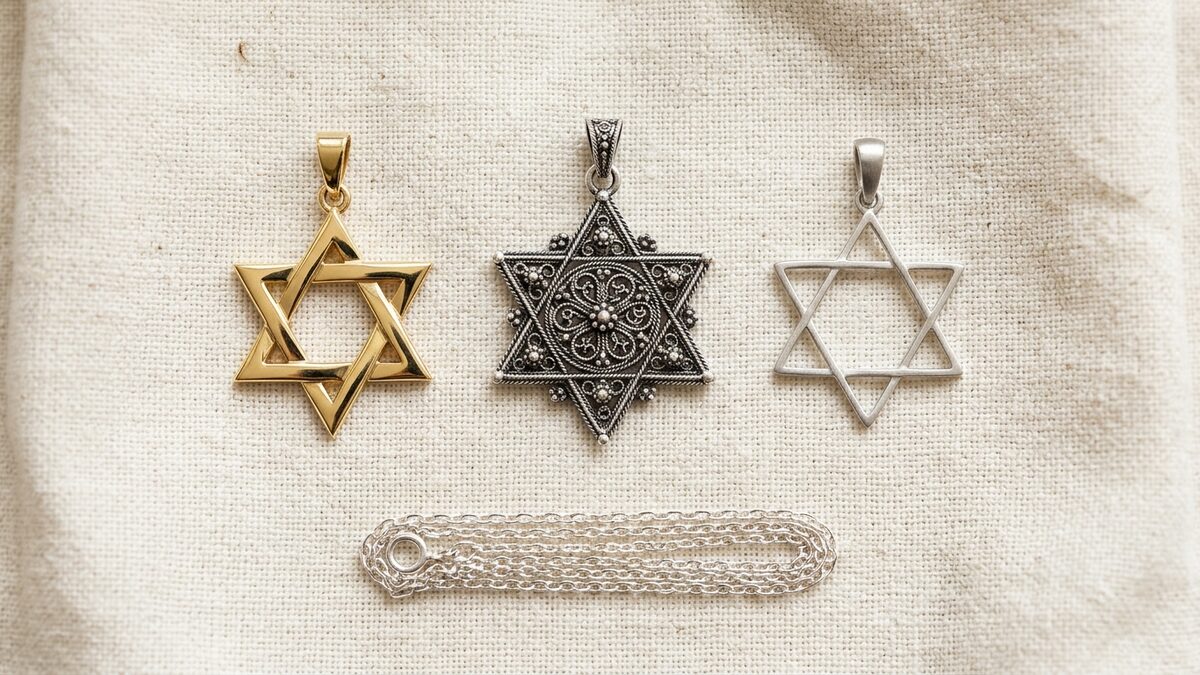
The six-pointed star, formed by two overlaid equilateral triangles, predates its association with Jewish identity by a wide margin. Versions of the hexagram appear in Islamic, Hindu, and early Christian decorative traditions, often as an ornamental motif with no specific religious charge. Its consolidation as a Jewish symbol is comparatively recent, gathering force in central Europe during the seventeenth and eighteenth centuries, becoming a community emblem in the nineteenth, and taking on its modern weight after the twentieth.
Worn as a pendant, the symbol carries that full history quietly. For some wearers it is a marker of faith and observance. For others it is a tie to family, to a grandparent, to a place. For many it is simply a way of carrying identity at the throat, neither announced nor hidden. None of these readings is more legitimate than another, and a well-made pendant accommodates all of them without insisting on one.
Three design traditions worth knowing
Most Star of David pendants on the market today belong, loosely, to one of three design lineages. Recognizing which lineage a piece sits in helps a buyer judge whether the execution matches the intent.
The first is the classical interlocked triangles. Two flat triangles, overlapping cleanly, with the points sharp and the intersections geometrically true. This is the form most people picture, and it is also the form that punishes sloppy execution. A stamped version will show rounded points, uneven leg lengths, and intersection lines that wander. A struck or cast version from a careful workshop holds its geometry under a loupe, with the six outer points reading as identical isosceles triangles and the inner hexagon sitting symmetrically at the center.
The second is Yemenite filigree. This tradition, carried by Yemenite Jewish silversmiths and later adapted in Israeli workshops, builds the star from twisted wire and granulation rather than from solid sheet. The result is a pendant with depth: the outline of the star is drawn in fine wire, the interior is filled with rosettes, beads, and coiled spirals, and the back is often as carefully finished as the front. Filigree work is slow, requires a steady hand at the torch, and does not survive being scaled down past a certain size. A small filigree star that looks crisp at arm's length and confused under magnification has usually been cast from a master rather than built by hand.
The third is the contemporary minimalist treatment. Here the star is reduced to its essential geometry, often as a single open outline in gold or platinum, sometimes with one element broken or offset as a designer's gesture. The minimalist mode is the easiest to do badly, because there is nowhere for poor finishing to hide. A clean minimalist star depends entirely on the quality of the metal, the precision of the cut, and the polish on every edge.
What to look for in the metal and the finish
Beyond style, a few practical cues separate a considered piece from a souvenir. The first is the metal itself. A pendant intended to be worn daily for decades should be in a metal that suits that life: 14k or 18k gold, sterling silver, or platinum, with a clearly stamped hallmark on the bail or the back of the star. Plated brass and unmarked alloys are common at the lower end of the market and tend to discolor or wear thin at the points within a few years of regular wear.
The second is the bail, the small loop that connects the pendant to the chain. A good bail is proportional to the star, smoothly soldered, and finished to the same standard as the front face. A bail that is visibly thicker than it needs to be, or that shows a rough solder seam, signals a workshop that finished the front and stopped thinking. On filigree pieces the bail is often integrated into the design rather than added afterward.
The third is the back. Turn the pendant over. A flat, polished back with a clean hallmark is the baseline. A back that shows casting porosity, file marks, or an indistinct stamp suggests a piece that was made to be glanced at, not examined. Yemenite filigree work, in particular, is often judged by how the back is finished, since the tradition treats both faces as legitimate views of the object.
A pendant chosen with attention to these details tends to settle into its wearer's life rather than out of it. The symbol is durable enough to carry whatever meaning the wearer brings to it, and the object is built to hold that meaning at the throat for a long time.