The Jewish Wedding Ring: Tradition and Meaning
Among the objects a couple will own, few carry as much weight for their size as the wedding ring. In Jewish tradition the ring is deliberately plain: a single unbroken circle of gold, chosen for what it says rather than what it shows.
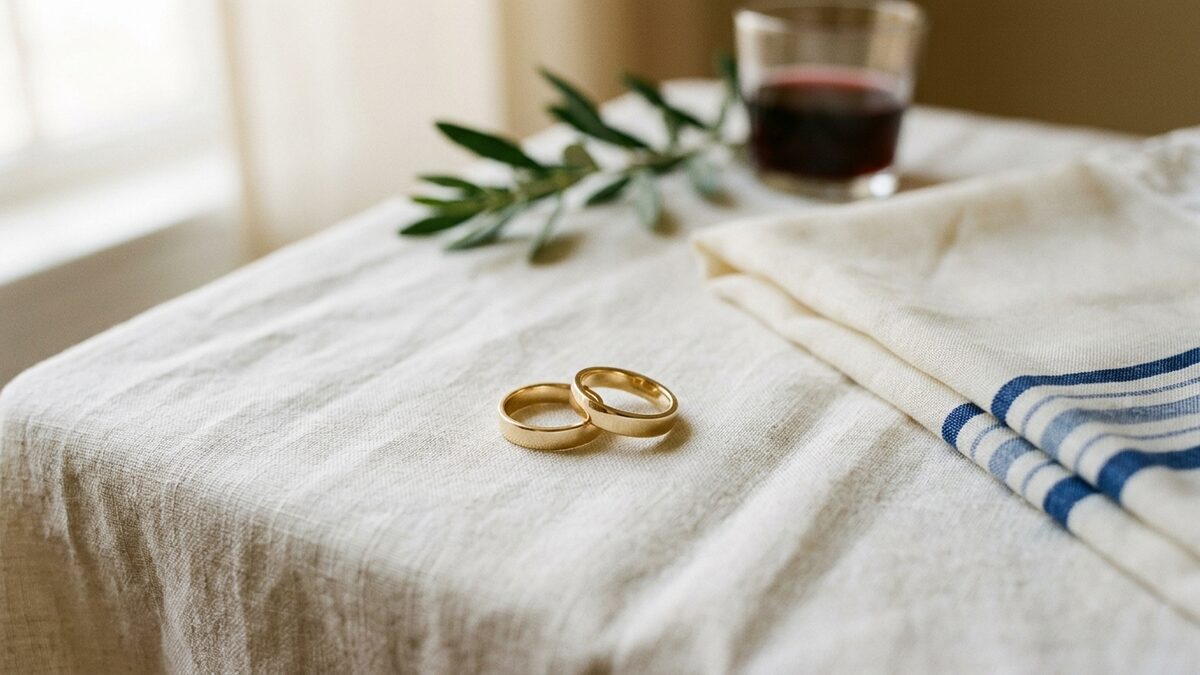
The wedding ring sits at the center of the Jewish marriage ceremony. Under the chuppah, the canopy that stands for the home a couple will build, the ring is given from one hand to another and the marriage is made. What that ring looks like is not an afterthought. Custom has shaped it carefully over generations, and the result is an object defined by restraint.
Why the ring is a plain, unbroken circle
The oldest instinct behind the Jewish wedding ring is simplicity. By long-standing custom the band is plain gold, smooth and whole, without stones set into it. Several threads of tradition point the same way. A ring with no gemstones can be valued honestly at a glance; its worth is in the metal itself, so there is no question or misunderstanding about what is being given at the moment of the marriage. The gift must be clear, and clarity is easiest when nothing is hidden.
The circle carries its own meaning. A band with no beginning and no end is read as a picture of continuity, of a bond meant to hold without interruption. An unbroken ring, solid all the way through rather than hollowed or interrupted, echoes that idea in the object itself. For many families the preference for a plain band is also a matter of humility: the ring is understood by what it stands for rather than by display.
The plainness of the band is not a modern minimalist choice but an old one. For generations the preference has been for a ring whose value is self-evident and whose form is complete in itself. Elaborate ceremonial rings have existed in Jewish history, some large and architectural and meant to be shared by a community rather than worn, but the ring a bride actually keeps has tended toward the simple band. The through-line is the same idea: the ring should be whole, honest, and easy to understand.
Tradition commonly places the ring on the index finger of the right hand during the ceremony, after which many wear it on the more familiar ring finger in daily life. The groom's recitation as the ring is given sets the words of the marriage to the act of placing it. These customs vary between communities, and couples who want to follow a particular practice usually speak with the officiant who will stand with them under the chuppah.
Choosing a Jewish wedding ring today
Couples choosing a ring today tend to weigh the same few things: the metal, the finish, the weight of the band, and whether to keep strictly to the plain circle or allow a small personal touch such as an inscription inside the band. A Hebrew engraving on the interior, a line from scripture or a couple's initials, keeps the outer surface plain while adding something private. Because that engraving sits where only the wearer feels it, it honors the tradition of an unadorned face.
On metal, the usual choice is between yellow, rose, and white gold. Yellow gold is the most traditional and reads warmest against most skin. Rose gold has a softer, slightly vintage tone. White gold suits those who prefer a cooler, more contemporary look. Yehood works in 14K yellow, rose, and white gold, and in sterling silver, with metal that is solid throughout rather than plated over a base, which matters for a ring meant to be worn every day for a lifetime.
Weight is a quieter decision than metal but worth making deliberately. A heavier band feels substantial and tends to resist bending, while a lighter band sits almost unnoticed through a long day. Neither is more correct; it is a matter of how the ring should feel to the person wearing it for decades. Width works the same way: a narrow band reads delicate, a wider one more present. Trying a few widths on the actual finger, rather than judging from a picture, is the only reliable way to choose.
Couples often ask what makes a good ring for them specifically. For someone who works with their hands, a lower-profile band with a comfortable rounded inner edge wears better day to day. For a couple who want their rings to speak to each other, matching the metal and finish across two bands keeps them clearly a pair without making either ring ornate. For a more traditional ceremony, a plain yellow gold band with an interior Hebrew inscription is a natural choice that asks no compromise of custom.
A plain gold band is also a practical object. Without raised stones to catch and loosen, a smooth circle holds up well to constant wear, which is part of why the form has lasted. When people ask whether a plain band holds its value, the honest answer is that a solid gold ring carries the worth of its metal for as long as it exists; its meaning, of course, is not something the market sets.
A few things are worth checking before buying. Confirm the karat and that the metal is solid rather than plated. Get the finger sized properly, since a band worn daily should sit comfortably through warm and cold weather alike. Ask about engraving and sizing before the piece is made rather than after, because personalized and custom-sized work is handled differently from a stock item. Yehood takes a limited number of custom requests, including metal changes and bespoke sizing, and gives an estimate before the work begins.
Caring for a plain band is simple, which is another quiet advantage of the form. Warm water, mild soap, and a soft cloth keep gold bright, and because there are no settings to inspect, there is little that can work loose. A ring worn constantly will gather fine surface marks over the years; many people come to value those as a record rather than a flaw, though a jeweler can refinish a band if a fresh surface is wanted.
For all the attention paid to the ring, the heart of the tradition is plain to see. A single circle of honest metal, given openly and worn without interruption, says what a couple means it to say. That is the quiet logic of the Jewish wedding ring, and it is why the simplest band is often the one that carries the most.