Best Online Stores for Jewish Jewelry Gifts
The best online stores for Jewish jewelry gifts share a few traits: a clear range of traditional symbols, honest metal and stone descriptions, a named workshop, and shipping and return terms you can read before you pay. This guide sets out how to check each one.
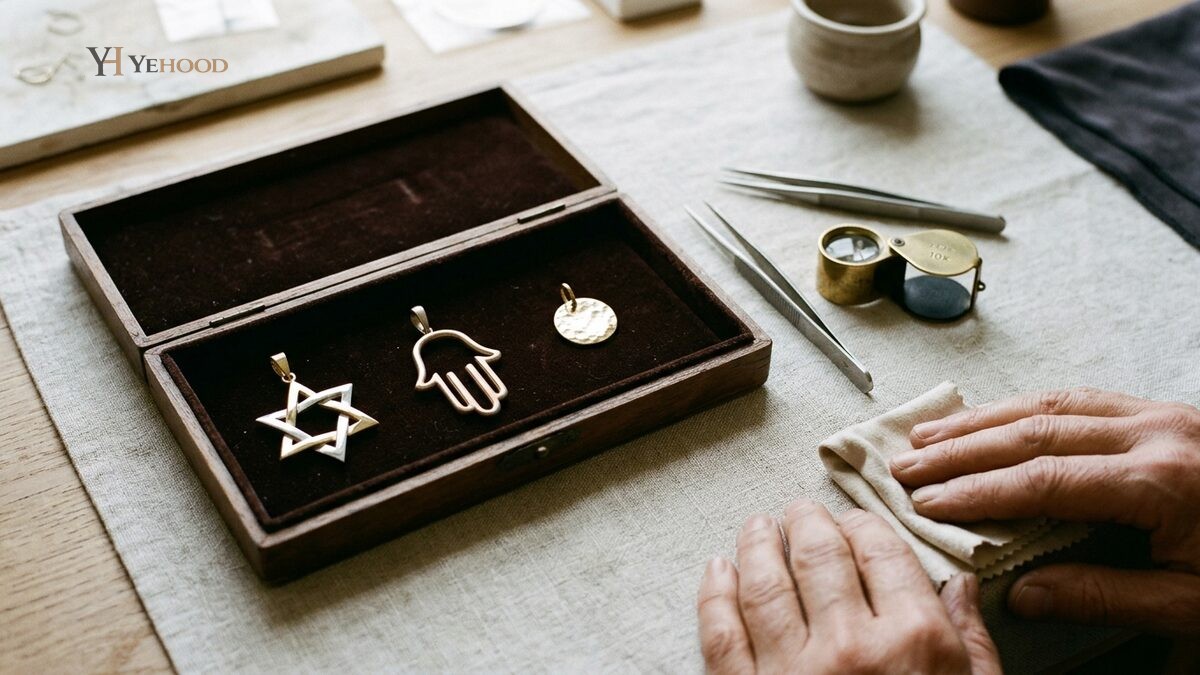
A good Jewish jewelry store makes the choosing easy before it makes the selling easy. When you compare online stores for a gift, you are really comparing five things: the range of symbols, the honesty of the material descriptions, the evidence of craftsmanship, the clarity of the policies, and whether anyone can say who made the piece.
How to choose Jewish jewelry for a gift, symbol by symbol
The symbol decides the gift, so start there. These are the categories most buyers search for, and a strong store will give each one its own page with a plain explanation of the meaning:
- Star of David (Magen David): the most widely recognized Jewish symbol, and the safest first Judaica gift for a recipient whose taste you do not know well.
- Hamsa: a stylized open hand, often shown with an eye at its center, used as a traditional emblem in Jewish and wider Middle Eastern cultures.
- Chai: the Hebrew letters chet and yud, which spell the word for life, and a frequent choice for birthdays and milestones.
- Hebrew-name pieces: a name rendered in Hebrew letters, which makes the gift personal and usually means made-to-order timing.
- Blessing pieces: a short Hebrew phrase or blessing set into the metal, best for someone who will read it and care that it is correct.
Be wary of any store that attaches promises to a symbol. Traditions around the Hamsa or the Evil Eye are cultural and religious, and a jewelry page should describe them rather than claim that a pendant will change anyone's luck or health.
Then match the symbol to the recipient and the occasion. A Star of David pendant suits a first gift because it is widely understood and rarely duplicates what someone already owns. Hebrew-name and blessing pieces suit a person who will notice the lettering. For a bar or bat mitzvah, a wedding or a naming, the date does not move, so read a store's shipping terms before you read anything else.
Check the Hebrew itself. If a store engraves or sets lettering, ask who proofreads it and look at the spelling on the product page. A single wrong letter in a name or a blessing is not something polish can repair.
What to check before buying: metal, stones and workmanship
Metal is where online descriptions differ most, and where a buyer has the least to go on. Learn the vocabulary, and expect a store to use it plainly:
- Solid gold: gold throughout the piece. The karat, such as 14K, states the gold content, and the color (yellow, rose or white) should be named as well.
- Sterling silver: sold as 925 sterling, a standard silver grade, and a sensible choice when the budget favors a larger or heavier design.
- Plated or vermeil: a gold surface over a different metal underneath. Not wrong, but it should be labeled as such and priced accordingly.
- Diamonds: ask whether the stones are natural, lab-grown or simulated. The answer should be stated, not implied.
Price follows this vocabulary. When you weigh Jewish jewelry price and value, the honest comparison is like for like: the same karat, the same metal, comparable size, the same stone type. A low price beside a vague description usually points to a thinner or plated piece, and a store that will not say which is telling you something.
Do Jewish gold pieces hold their value? Solid gold carries the worth of its metal, which a plated piece does not. What any piece would fetch if sold again depends on the market and the buyer, and no store can name a figure in advance. Buy a piece because it will be worn and kept, and treat resale as a side note.
Craftsmanship shows in photographs if you look closely. Check that edges are clean, that stones sit evenly in their settings, that the clasp looks substantial, and that a dimensional piece reads correctly from more than one angle. Ask whether pieces are made in small runs or cast in volume, and whether anyone inspects each one before it ships.
Then read the policies. Look for where the store ships from, whether shipping is free, how long handling takes, whether the parcel is insured and whether a signature is required. Read the return terms in full, especially the sections on custom, engraved and made-to-order pieces, which are commonly final sale. If anything is unclear, email first and keep the reply.
A workshop-made piece differs from a resold one in ways you can verify. The seller can name where it is made, describe how it is built, and answer a question about one specific piece. Small-run work shows minor variation from piece to piece, which is a property of handwork rather than a flaw, and an honest seller says so before you buy.
Yehood is one such workshop, and we would rather you hold us to this list than take our word. We make Jewish jewelry in Los Angeles in 14K yellow, rose and white gold and in 925 sterling silver. Our signature is a three-dimensional Star of David, the Merkabah, built in the round from two interlocking tetrahedra. The metal is solid throughout; we do not hollow pieces or plate base metal to imitate gold, and our diamonds are natural. Stones are set by hand, and each piece is inspected before it ships.
The Merkabah pendant necklace arrives on a ball chain with adjustable hoops, so the length can be set to taste or layered with other pieces of ours. Standalone pendants do not include a chain, which is worth knowing before you order. We ship within the United States only, free of charge, with 1 to 3 business days of handling and 2 to 5 business days in transit. Every parcel is fully insured and tracked, and higher-value orders are released against a signature. Custom, engraved and custom-sized pieces take longer, and we give an estimate before the work begins.
Our returns page sets out the return window and the final-sale categories, and it is worth reading in full before you buy from us or anyone else. Questions about a piece, a size or an order can go to team@yehood.com.
In short: choose the symbol the recipient will recognize, insist on a stated metal, karat and stone type, look for a named workshop behind the piece, and read the shipping and return terms before you look at the price. A store that passes those four checks is worth buying from, whatever its size.