Ani L'Dodi Ring Meaning in Jewish Tradition
Few phrases carry a wedding as quietly as Ani L'Dodi Vedodi Li. Six Hebrew words from the Song of Songs, worn on the hand, hold an entire covenant between two people. Here is what the inscription means, where it comes from, and what to look for when you commission one in gold.
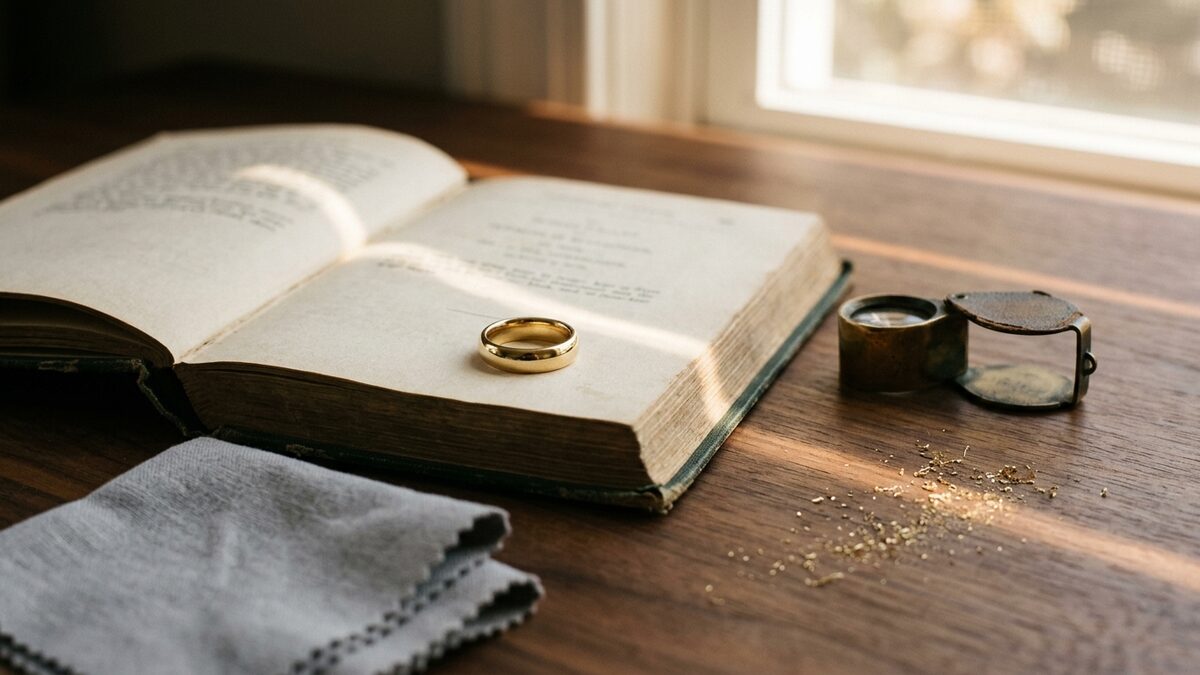
The inscription reads אני לדודי ודודי לי, transliterated as Ani L'Dodi Vedodi Li and often shortened on a band to Ani Ledodi. The usual English is 'I am my beloved's, and my beloved is mine.' It comes from the Song of Songs, the biblical love poem known in Hebrew as Shir HaShirim and traditionally attributed to King Solomon. The practice of engraving rings with lines from Jewish texts is an old one, and couples have long chosen this verse because it speaks to partnership in plain, reciprocal terms: each belongs to the other, equally and by choice.
What makes the line suited to a ring is its symmetry. The Hebrew folds back on itself, 'my beloved's, and my beloved is mine,' so that no word sits above another. On a circular band that has no beginning and no end, that balance reads as a small argument about what a marriage is meant to be.
Where the Ani Ledodi line comes from
The Song of Songs is unusual in the Hebrew canon. It is frankly a love poem, and generations of readers have taken it on two levels at once: as the voice of two people in love, and as a figure for the bond between the divine and the community. A couple who inscribes Ani Ledodi on a wedding band is drawing on both readings without having to choose between them. The verse appears in full as Ani L'Dodi Vedodi Li, and some couples set the whole phrase inside the band while others keep only the opening words on the outer face.
The phrasing has also become a quiet favourite because it reads as equal. Older betrothal language often ran in one direction, from one partner to the other. Ani Ledodi Vedodi Li answers itself in the same breath, which is why many modern couples who want a traditional text without a traditional hierarchy land on this verse in particular. It says the same thing from both sides of the hand.
Because the custom predates any single style, there is no one correct way to present it. Some bands carry the Hebrew alone. Others pair it with an English translation on the inner surface, so the wearer reads the meaning and the world sees the letters. The decision is personal, and it tends to follow how a couple relates to Hebrew in the rest of their life.
Choosing an Ani Ledodi ring: metal, lettering, and value
If you are weighing how to choose an Ani Ledodi ring, start with the metal, because it sets both the look of the lettering and the long-term wear. Yehood works in 14K yellow, rose, and white gold, and in sterling silver. Yellow gold gives Hebrew letters a warm, traditional weight and hides everyday marks well. White gold reads cooler and more modern, and makes engraved strokes crisp against the surface. Rose gold sits between the two and flatters warmer skin tones. Sterling silver is the most accessible entry point and takes fine lettering cleanly, though it asks for a little more upkeep than gold.
The lettering itself is where a good piece earns its keep. Hebrew is a script of fine verticals and connecting strokes, and crowded or shallow engraving turns Ani Ledodi into something hard to read within a year of daily wear. Yehood cuts and finishes by hand and takes a limited number of custom pieces, including engraving and bespoke sizing, so the depth and spacing of the letters can be set to the width of your band rather than forced onto a stock template.
A short buying guide for the band itself: decide early how much of the verse you want, because a full Ani Ledodi Vedodi Li needs more room than the opening two words and may push you toward a wider band. Measure the finger at the end of the day when it is largest, and if the ring is a surprise, borrow one the recipient already wears rather than guessing. Yehood gives a time estimate before engraving or custom sizing begins, not after, so you know what to expect before committing.
Before buying, there are a few things worth checking. Confirm that the metal is solid rather than plated, since plating wears through exactly where a ring is handled most. Yehood keeps metal solid throughout and does not hollow pieces to cut weight. If you want stones, ask whether they are natural; Yehood sets natural diamonds by hand and does not use lab-grown or simulated stones. And because this is handwork, expect minor variation between pieces, which is a property of the craft and not a flaw.
As a gift, an Ani Ledodi ring suits the obvious milestone, a wedding or an engagement, but it is not limited to them. Couples mark anniversaries with it, and some choose it for a vow renewal, where the reciprocity of the line reads as earned rather than hoped for. Worn as a stacking band, it layers comfortably with a plain wedding ring or alongside other Yehood pieces, so the inscription can join a hand that already tells a story.
On the question of whether these rings hold value, the honest answer is that a personalized, engraved piece is made to be kept, not resold; its worth is largely in the gold and the workmanship. Solid 14K gold and hand-set natural stones carry real intrinsic value, and a well-cut inscription does not degrade the way plating or glued settings do. If you ever need it resized or refreshed, solid gold can be worked by a jeweller in a way that thin plated pieces cannot, which is one more reason the material choice at the start matters. Buy it as an heirloom rather than an investment, and it does the job it was made for.
A ring is a small object asked to carry a large promise. Ani L'Dodi Vedodi Li has done that for a very long time, and rendered honestly in gold, with letters cut deep enough to last, it still does.